

Someone who checks your boat every week looks her over and tells you what they saw. Yacht management includes that same weekly check and then handles what comes next: the routine care, the vendors, the repairs and the storm plan, with a record you can read yourself.
Which one you need depends on how much of the upkeep you want to run yourself, and whether you can judge the work when it’s done. Plenty of owners who keep their boat close to home use one or the other, usually because they’re short on time or don’t know the systems well.
What a weekly boat check usually covers
A lot of owners already have this in some form. A captain stops by, a neighbor on the dock keeps an eye on her, or a local service comes aboard on a schedule. What’s included varies, so ask exactly what gets looked at.
Most checks are a walk-through. Someone looks at the lines and fenders, the shore-power connection and the bilge, and sends you a short note or a photo.
That’s useful. A chafed line found early is a small fix. What a check on its own usually doesn’t include is arranging repairs, managing vendors or getting the boat ready for a storm. If the note says something needs attention, the next steps are yours: finding the right technician, getting a quote, scheduling access and deciding whether the job was done properly.
For an owner who already runs the maintenance and has vendors they trust, that’s often all they want.
What yacht management adds
When we manage your boat, the weekly visit is where the work starts.
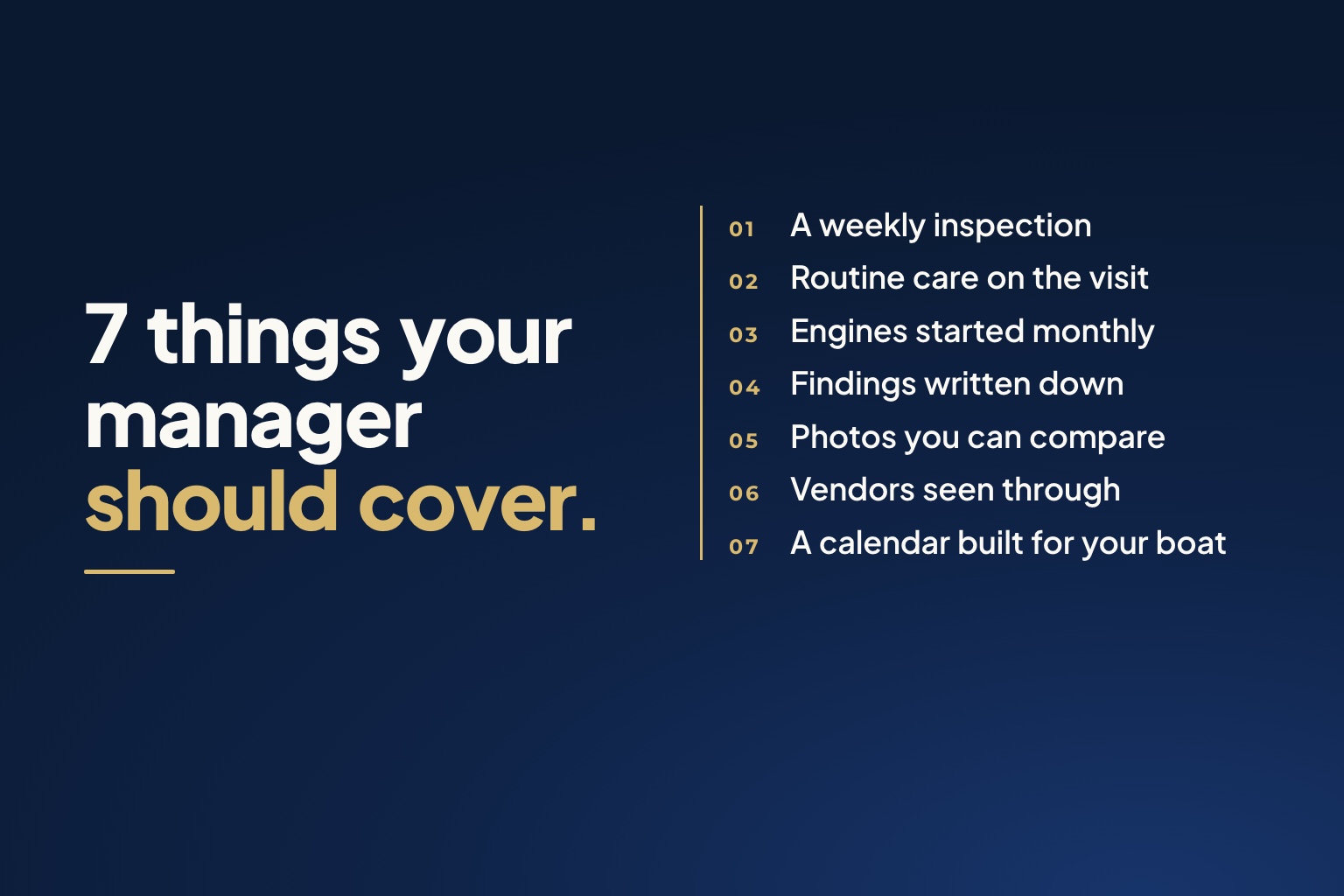
Every week we inspect her: bilge, power, batteries, fluids and systems, lines, fenders and the shore-power connection, and we confirm the air conditioning is working. Routine care happens on the same visit. Filters are changed when they’re due, the sea strainers for the engines, generators and air conditioning are checked and cleaned on site, and fire extinguishers are checked. If she hasn’t been run, we start the engines and generators once a month.
Anything we find is written up with its location, a category, a severity and photos. New photos are compared with earlier ones of the same equipment and spaces, so a possible change gets a closer look from a person before anyone calls it a problem.
Repairs and maintenance are done by vendors, and managing them is part of the service. We collect estimates, schedule access, follow the work and check it when it’s finished. Vendor invoices pass through to you with no markup.
We also build a maintenance calendar around your boat’s own equipment and how you use her. For hurricane preparation, she’s moved to a location agreed with you in advance, or hauled out. And you have your own sign-in to Harbor Guardian, the platform we use, where you can see inspections, photos, findings, work in progress and costs. For more on what the software does and where a person takes over, see What Harbor Guardian Does and What It Doesn’t.
Side by side
- A weekly check looks the boat over. Management inspects her weekly and does routine care on the same visit.
- A check usually ends with a short note. Management writes up each finding with its location, category, severity and photos, and compares new photos with earlier ones.
- After a check, repairs and vendors are usually yours to arrange. With management, we collect estimates, schedule the work and check it when it’s done, with no markup on vendor invoices.
- Storm preparation is usually outside a weekly check. Under management, the plan to move or haul her is agreed in advance.
- A check leaves maintenance planning with you. Management builds a calendar around your boat.
How to decide
Weekly checks fit if you have the time and the know-how to manage the maintenance and the vendors yourself. You get a regular report and you handle what it turns up. That’s a sound way to run a boat.
Management fits if you don’t have that time, don’t want to chase vendors, or can’t tell whether a repair was needed or done right. A quote for a new pump reads the same whether the old one had years left or was failing, and an invoice marked paid doesn’t show you how the job was done.
Ask yourself who handles it when the note says something’s wrong. If the honest answer is “me, and I know who to call,” weekly checks may be all you need. If the answer is “I’m not sure,” management covers that gap.
If you also want someone to run the boat, that’s a separate question. Captain services with USCG-licensed captains are available from us and billed separately. Do You Need a Captain, a Yacht Manager, or Both? walks through how the two roles differ.
How Reliant works
We manage boats in Cape Coral and Southwest Florida, and in Port Canaveral and on the Space Coast. There’s no contract. Management is month to month, and the scope and fee are set after an initial vessel review, so you know what’s covered before you commit.
If you’re not sure management is what you need, you can start with a one-off inspection and see the kind of record we keep. Whoever you’re considering, it’s worth asking a few direct questions first, and 7 questions to ask a yacht management company before you hire is a good place to start.
Message us with your boat and where she’s kept, and we’ll set up an initial vessel review or a one-off inspection.